
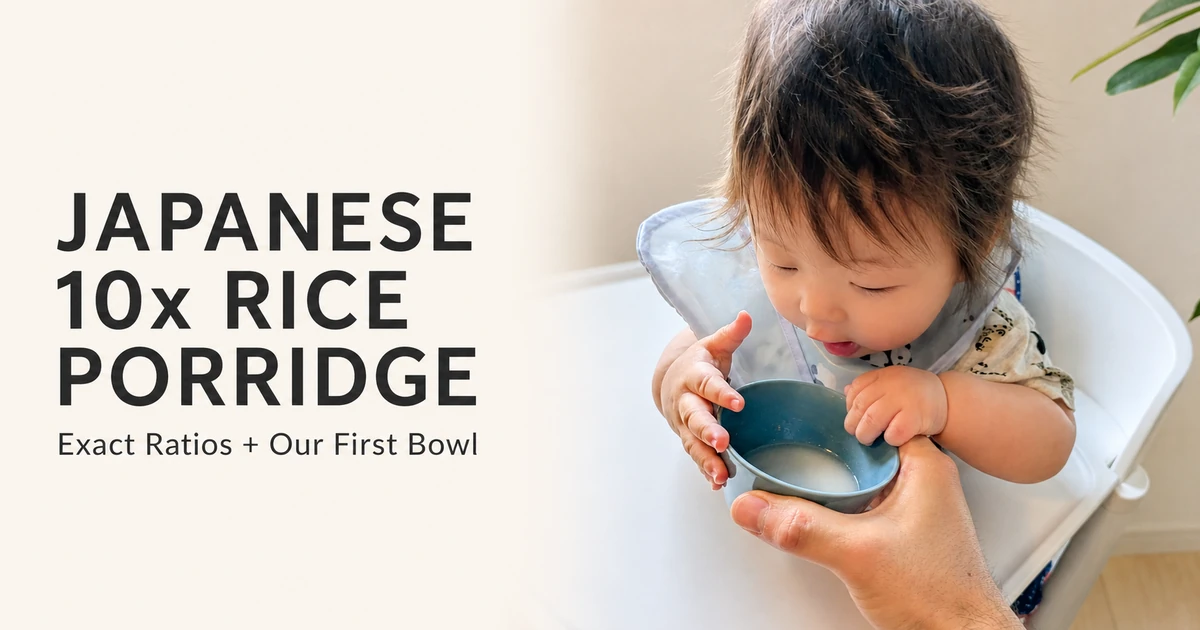
Our baby’s first reaction to rice porridge was not a dramatic “I love it.” It was a wide-eyed look, one cautious taste—and then a determined attempt to grab both the spoon and the bowl.
Hi, I’m Yama Papa—a Japanese dad sharing what actually works in our home. For our family in Japan, 10-bai-gayu (10x rice porridge) was the starting point for solids. The name sounds technical, but the basic idea is simple.
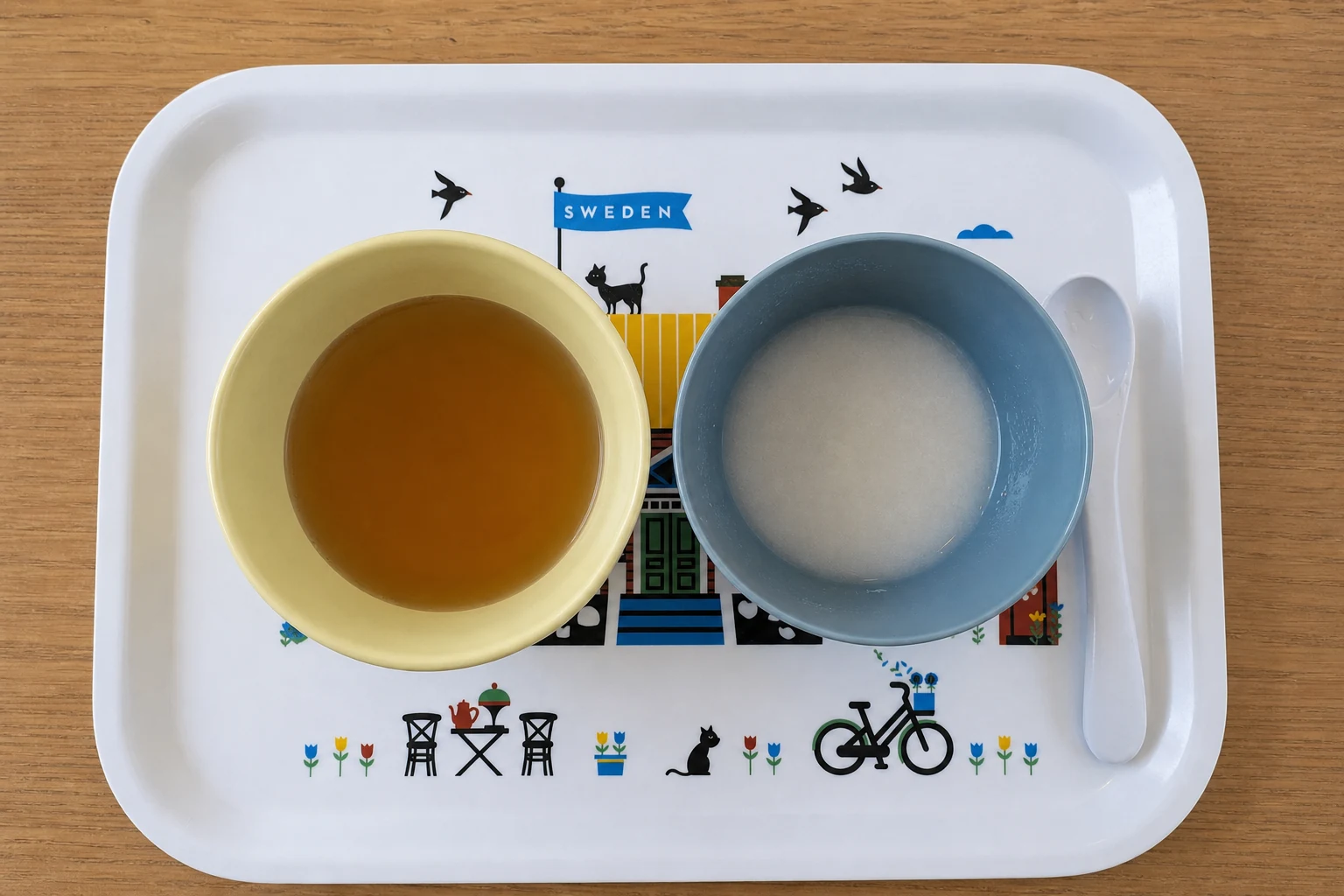
Quick answer: When starting with uncooked rice, use 1 part rice to 10 parts water by volume. When starting with already cooked rice, a practical shortcut is about 1 part cooked rice to 4 parts water. Cook until very soft, then mash or strain to match your baby’s stage. Let it cool before serving.
This is a general preparation guide based on Japanese public-health materials, not individualized medical advice. Babies develop at different rates. Ask your pediatrician or another qualified health professional if you have questions about readiness, allergies, swallowing, growth, or your baby’s specific needs.
- What does “10x rice porridge” mean?
- Before you make the first bowl, check readiness
- The two ratios parents most often mix up
- Method 1: Make 10x rice porridge from uncooked rice
- Method 2: Make a quick batch from cooked rice
- How to tell whether the texture is right
- What happened with our baby’s first bowl
- Freezing small portions without making too much
- 10x rice porridge and U.S. infant cereal are not nutritionally identical
- Frequently asked questions
- A calm first bowl is enough
- Sources
What does “10x rice porridge” mean?
Japanese okayu is rice cooked with extra water until it becomes very soft. The “10x” in 10-bai-gayu refers to the starting proportion traditionally used for a thin porridge: one volume of uncooked rice to ten volumes of water. It does not mean that the finished porridge is ten times thicker.
The exact final thickness changes with the pot, heat, soaking time, rice variety, and evaporation. That is why the ratio is a starting point and the finished texture is the real check.
For a new eater, Japanese guidance commonly starts with a smooth, soft consistency. As a baby becomes comfortable eating, the texture can gradually become less uniform. There is no prize for rushing to a lumpier texture, and there is also no need to keep every bowl perfectly silky forever.
Before you make the first bowl, check readiness
Japanese guidance commonly places the start of complementary feeding around 5 to 6 months, while U.S. CDC guidance says most children can begin foods other than breast milk or infant formula at about 6 months and not before 4 months.
The calendar is only part of the decision. Useful readiness signs include:
- Sitting with support and holding the head steady
- Bringing objects to the mouth
- Swallowing food instead of consistently pushing it back out
- Showing interest in food
Continue breast milk or infant formula as your baby’s primary nutrition during the early stage of solids, following your clinician’s advice.
The two ratios parents most often mix up
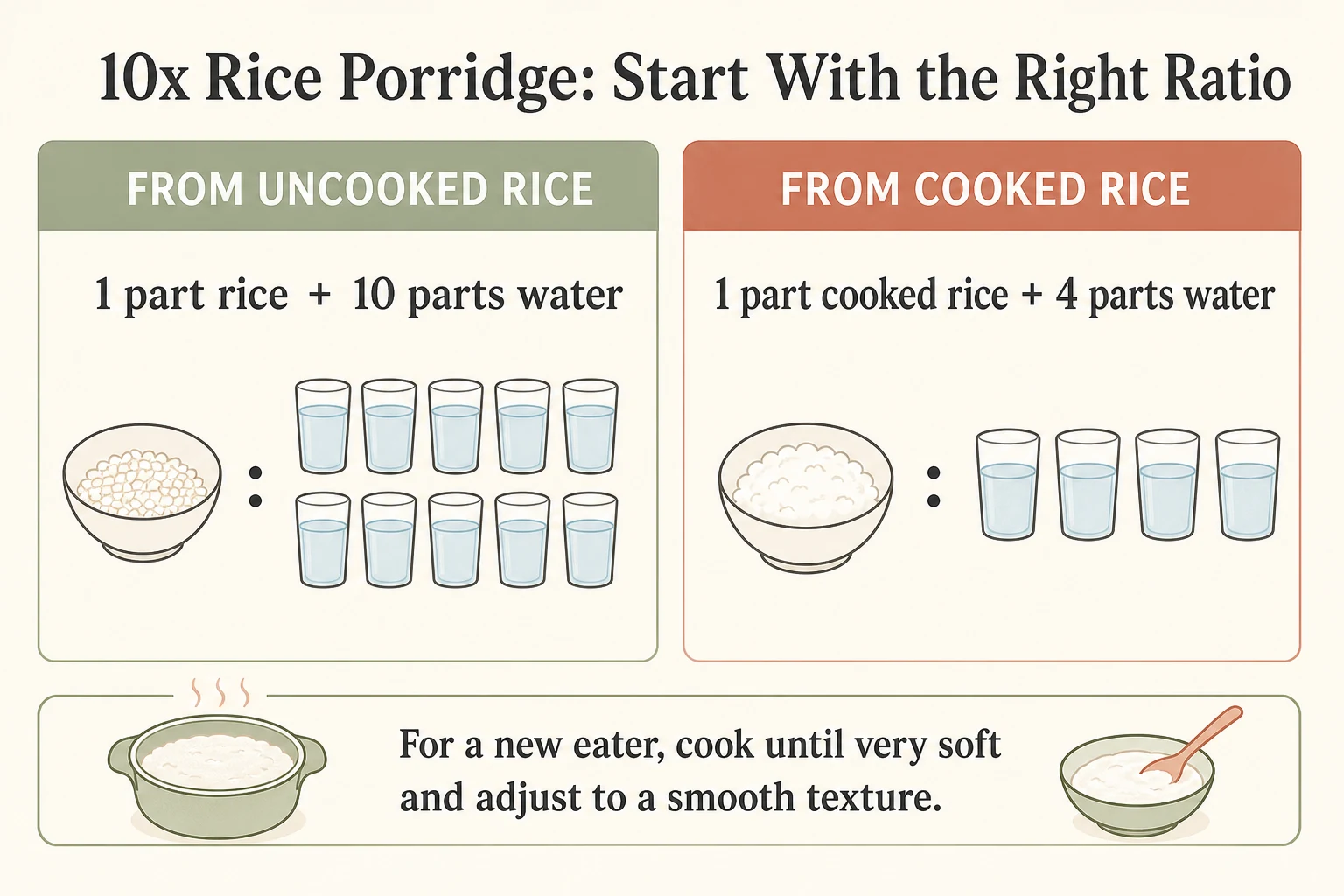
| Starting ingredient | Practical ratio by volume | Small-batch example |
|---|---|---|
| Uncooked rice | 1 rice : 10 water | 1 tablespoon rice + 10 tablespoons water |
| Cooked rice | About 1 cooked rice : 4 water | 1 tablespoon cooked rice + 4 tablespoons water |
These two methods do not begin with the same ingredient, so their numbers should not match. Cooked rice has already absorbed water. Some Japanese local guides use a cooked-rice range of about 1:4 to 1:5; use the finished texture as your guide.
Method 1: Make 10x rice porridge from uncooked rice
Ingredients
- 1 tablespoon uncooked Japanese short-grain rice
- 10 tablespoons water
You can scale the recipe up by keeping the same volume ratio. For a first attempt, a small batch makes it easier to learn the texture without filling the freezer with something your baby may not be ready for yet.
Equipment
- Small heavy-bottomed saucepan with a lid
- Measuring spoon or cup
- Fine strainer, baby-food masher, or small mortar
- Clean serving bowl and spoon
Step 1: Rinse and soak
Rinse the rice gently. Put it in the saucepan with the measured water and let it soak for about 30 minutes. Soaking helps the rice cook evenly, especially in a very small batch.
Step 2: Cook gently
Bring the mixture just to a boil, then reduce the heat to very low. Cover with the lid slightly ajar and simmer until the grains are extremely soft. A Japanese municipal example uses roughly 50 minutes for a small stovetop batch, followed by a short resting time.
Treat the clock as a guide, not the finish line. Small pans lose water quickly. Check occasionally to make sure the rice is not sticking or drying out. If necessary, add a little hot water.
Step 3: Rest, then smooth the texture
Turn off the heat and let the porridge rest, covered, for about 7 to 10 minutes. For a new eater, mash the softened grains thoroughly or press the porridge through a fine strainer. Add a little hot water if it becomes too thick during mashing.
Step 4: Cool before serving
Move a small amount to the serving bowl and allow it to cool. Stir well and check the temperature before offering it. Stay close and supervise your baby while eating.
Method 2: Make a quick batch from cooked rice
Ingredients
- 1 tablespoon plain cooked rice
- 4 tablespoons water
Steps
- Put the cooked rice and water in a small saucepan.
- Bring to a gentle simmer.
- Cook over low heat for about 15 to 20 minutes, stirring as needed, until the grains break down easily.
- Rest briefly, then mash or strain for your baby’s current stage.
- Add a little hot water if needed, then cool and check the temperature before serving.
This method is convenient when the family rice is already cooked. Use plain rice before it has been seasoned or mixed with other ingredients.
How to tell whether the texture is right
The finished porridge should be soft enough that the grains collapse with light pressure. For an early first-food texture, it should slide off the spoon slowly and should not contain firm rice centers.
Use these checks:
- Too thick: It sits like paste and does not move when the spoon is tilted. Stir in hot water a teaspoon at a time.
- Still grainy: The rice centers feel firm. Cook longer with a little more water, then mash again.
- Too watery: The rice and water separate immediately. Simmer a little longer, then rest.
- Skin forms while cooling: Stir the porridge thoroughly and recheck the temperature and consistency.
Your baby’s response matters too. Coughing, persistent gagging, or difficulty swallowing deserves attention; stop feeding and consult a health professional if you are concerned. Learn the difference between gagging and choking, and use age-appropriate first-aid guidance from a reliable medical source.
What happened with our baby’s first bowl
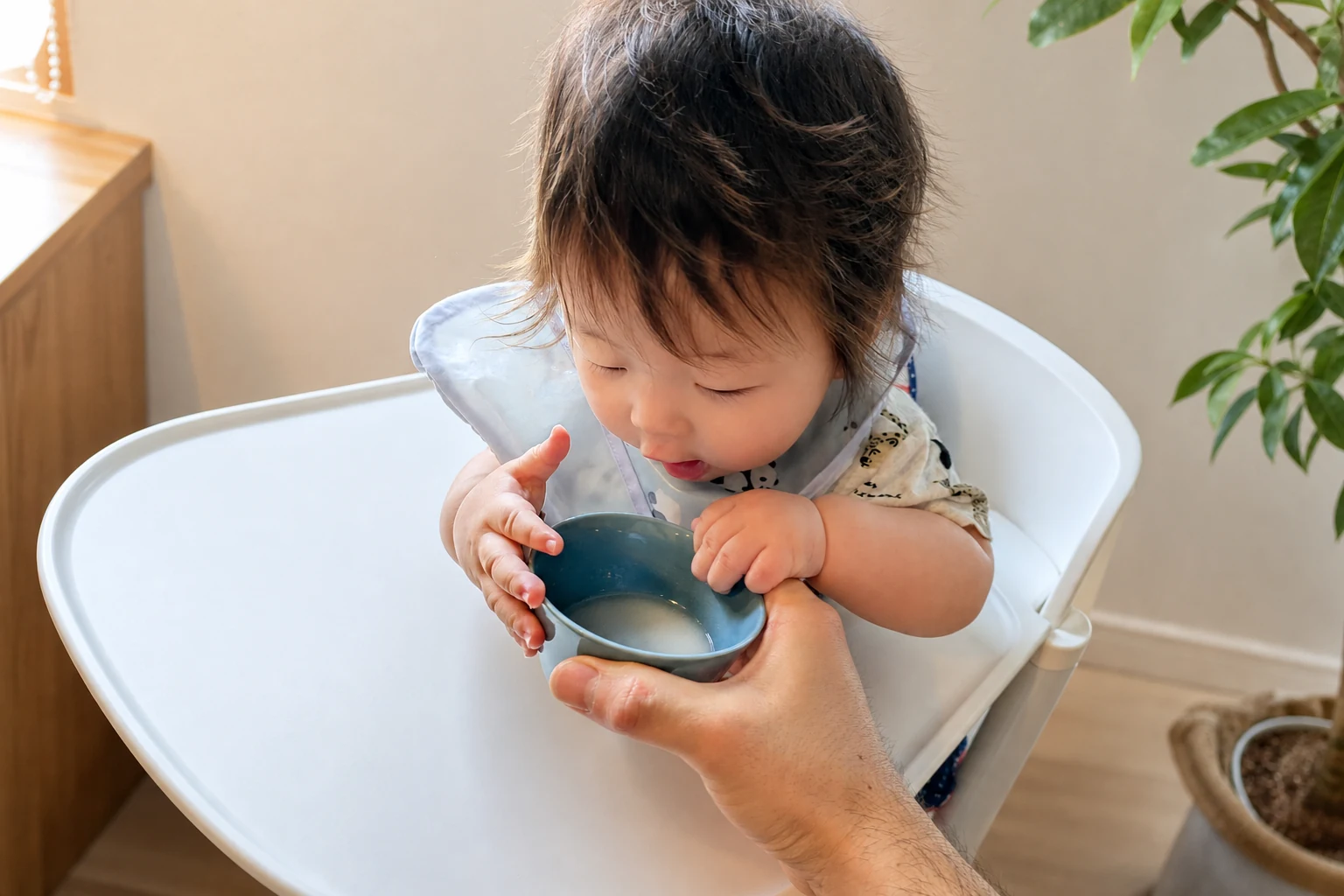
We prepared a very smooth bowl and expected the porridge itself to be the main event. Our baby looked surprised by the first taste, then became fascinated with the tools: one hand reached for the spoon, and the other went toward the bowl.
That small scramble changed how we thought about a “successful” first meal. The goal was not an empty bowl. It was a calm introduction to sitting, tasting, touching, and stopping. Our baby ate some, explored a lot, and we felt relieved that the first attempt did not need to be perfect.
One practical lesson was immediate: cool the porridge before the bowl reaches grabbing distance. Babies do not wait for a parent’s carefully planned sequence.
Freezing small portions without making too much
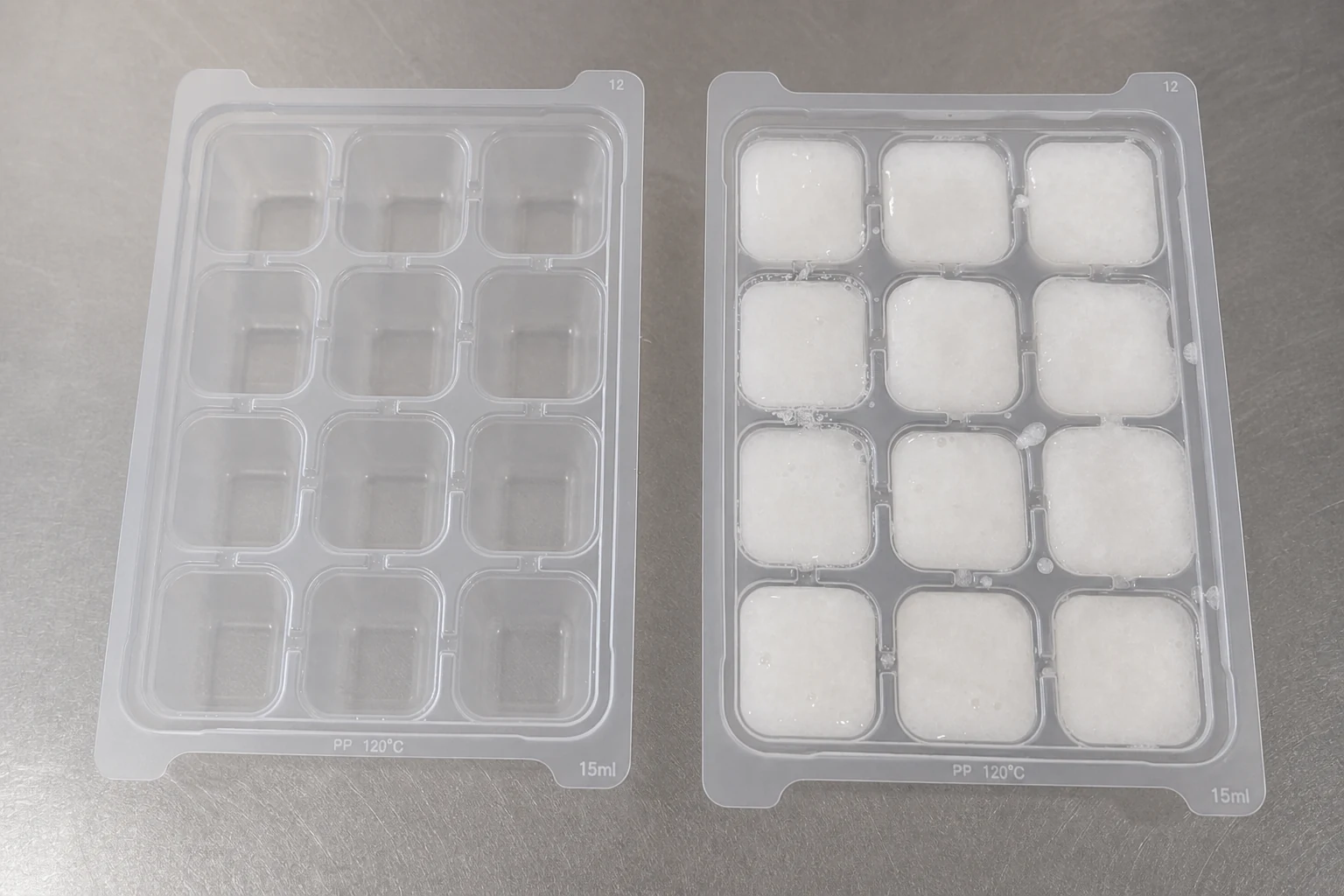
We used a Richell Tsukurioki subdivided freezing pack with 15 mL sections. The small compartments matched the tiny amounts we needed at the beginning and made it easy to thaw only a little at a time.
As an Amazon Associate, we earn from qualifying purchases.
- What we actually used: Richell 15 mL subdivided freezing pack on Amazon
- Why it helped us: The portion size suited the early stage, when a large cube would have created unnecessary leftovers.
- Who it may suit: Families who want small, separate portions and do not mind using a lightweight plastic tray.
- Who may prefer something else: Parents who want silicone, a rigid reinforced base, or much larger portions.
Our household aimed to use the frozen portions within about one week. That is our family practice, not a universal storage rule. Label the date, follow the tray maker’s directions and food-safety advice that applies where you live, discard food left in a serving bowl after feeding, and do not refreeze a thawed portion.
When reheating, heat the portion thoroughly, stir to eliminate hot spots, and then let it cool to a safe serving temperature.
A larger U.S. option we researched
The WeeSprout Silicone Baby Food Freezer Tray has 1.5-ounce sections, a clip-on lid, measurement markings, and a reinforced base. The manufacturer describes it as freezer-safe, top-rack dishwasher-safe, and made without BPA, PVC, or phthalates.
We have not used this tray in our home. It is a researched alternative for U.S. shoppers who prefer silicone and larger portions. A 1.5-ounce section is about three times the nominal volume of a 15 mL section, so it may be more useful after intake increases than for the very first spoonfuls.
You do not need a dedicated baby-food tray. Clean, small freezer-safe containers are a perfectly reasonable no-purchase option.
10x rice porridge and U.S. infant cereal are not nutritionally identical
Homemade rice porridge is a soft way to introduce the taste and texture of rice. It is not the same product as iron-fortified infant cereal. Do not assume that one automatically replaces the nutritional role of the other.
U.S. FDA advice also encourages parents to offer a variety of grains rather than relying only on rice, which can reduce exposure to inorganic arsenic and broaden the diet. Oats, barley, and multigrain infant cereals are examples the FDA mentions. Discuss iron and overall complementary-feeding needs with your child’s clinician.
The cultural bridge is simple: you can enjoy the Japanese okayu tradition without making rice the only grain or the only first food.
Frequently asked questions
Is 10x rice porridge the same as rice water?
No. Rice water is mainly the liquid, while 10x rice porridge includes rice cooked until very soft and then mashed or strained to an age-appropriate texture.
Do I have to use Japanese rice?
Japanese short-grain rice gives the familiar soft, cohesive okayu texture. If you use another plain rice, the cooking time and final texture may differ. The grain still needs to become fully soft.
Why is the cooked-rice ratio 1:4 instead of 1:10?
Cooked rice has already absorbed water. The 1:10 figure applies when the starting ingredient is dry, uncooked rice.
Should I add salt, sugar, broth, or seasoning?
For a simple first bowl, use plain rice and water. Ask your clinician before adding ingredients if allergy or medical considerations apply.
How much should a baby eat the first time?
The first feeding is an introduction, not a portion-size test. Follow your baby’s cues and your clinician’s guidance. Do not force the spoon or expect the bowl to be finished.
Can I make it in a rice cooker?
Many rice cookers have a porridge setting, but water ratios, minimum batch sizes, and cooking behavior vary. Follow your cooker’s manual and still check the finished softness and texture.
A calm first bowl is enough
Start with the correct ratio, cook until the center of every grain is soft, adjust the texture, and cool the porridge before serving. Then let the first meal be what it is: a small experiment shared by a baby and a parent.
If the spoon gets more attention than the porridge, you are not doing it wrong. In our home, that was part of the beginning.
Sources
- Japanese Ministry of Health, Labour and Welfare: Guide to Breastfeeding and Weaning (2019, Japanese PDF)
- CDC: When, What, and How to Introduce Solid Foods
- CDC: Choking Hazards
- FDA: Healthy Food Choices for Your Baby Aged 6–12 Months
- FDA: Inorganic Arsenic in Infant Rice Cereals—Guidance for Industry
- Shinagawa City: Infant Food Guide (Japanese PDF)

Comments