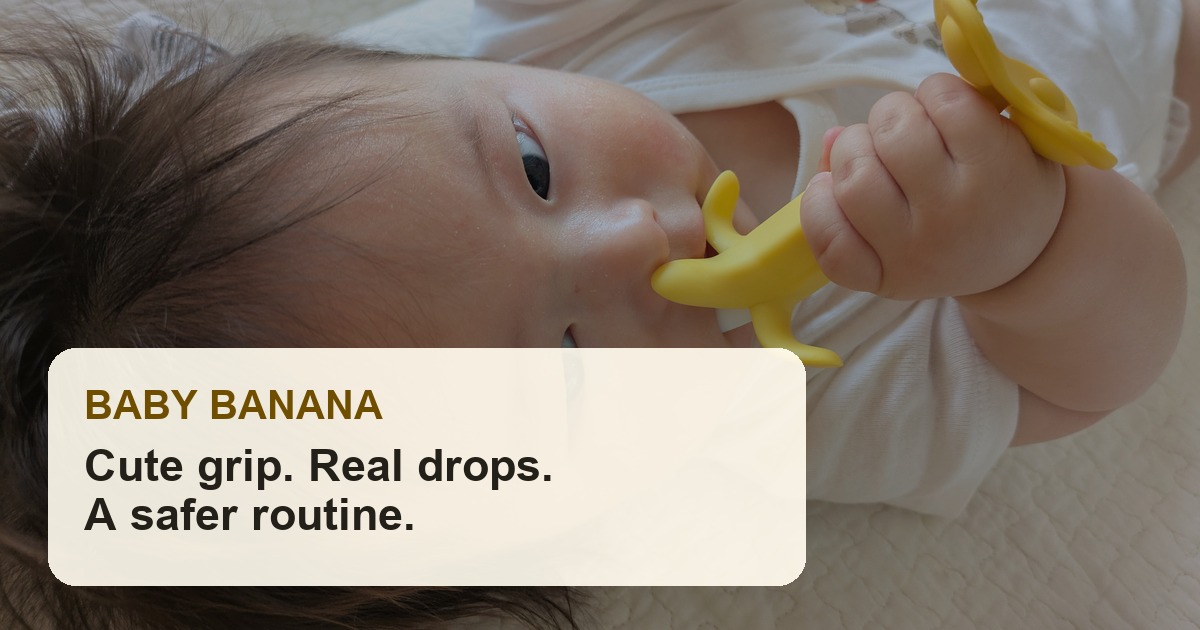
You do not need to finish a giant baby registry before your baby arrives. A safer, calmer plan is to prepare the few things you will need immediately, wait on gear that depends on your baby and home, and skip products that duplicate a job—or conflict with U.S. safety guidance.
Hi, I’m Yama Papa—a Japanese dad sharing practical ideas from Japan in a form families in the United States can actually use. This article is a researched guide, not a claim that our family has used every product mentioned below.
- The short answer: start with safety, not a giant registry
- Why a Japanese checklist looks different
- Buy before birth: the safety-first essentials
- Easy Japanese ideas to borrow without overbuying
- Buy later: gear that depends on your baby and home
- Five product categories: what to check
- Japanese products that need a U.S. safety check
- What you may be able to skip
- Your minimal baby essentials checklist
- Frequently asked questions
- Your next step: divide your registry into three columns
- Sources
The short answer: start with safety, not a giant registry
Think in three columns:
- Buy before birth: a safe sleep space, a rear-facing car seat if you travel by car, diapers, a few clothes, feeding supplies that match your plan, and basic care items.
- Buy later: an infant tub, stroller, carrier, and feeding tableware. Your home, baby’s size, and daily routine will tell you what works.
- Skip, borrow, or reconsider: duplicate gadgets, too many newborn-size clothes, and sleep products that do not match current U.S. safe-sleep guidance.
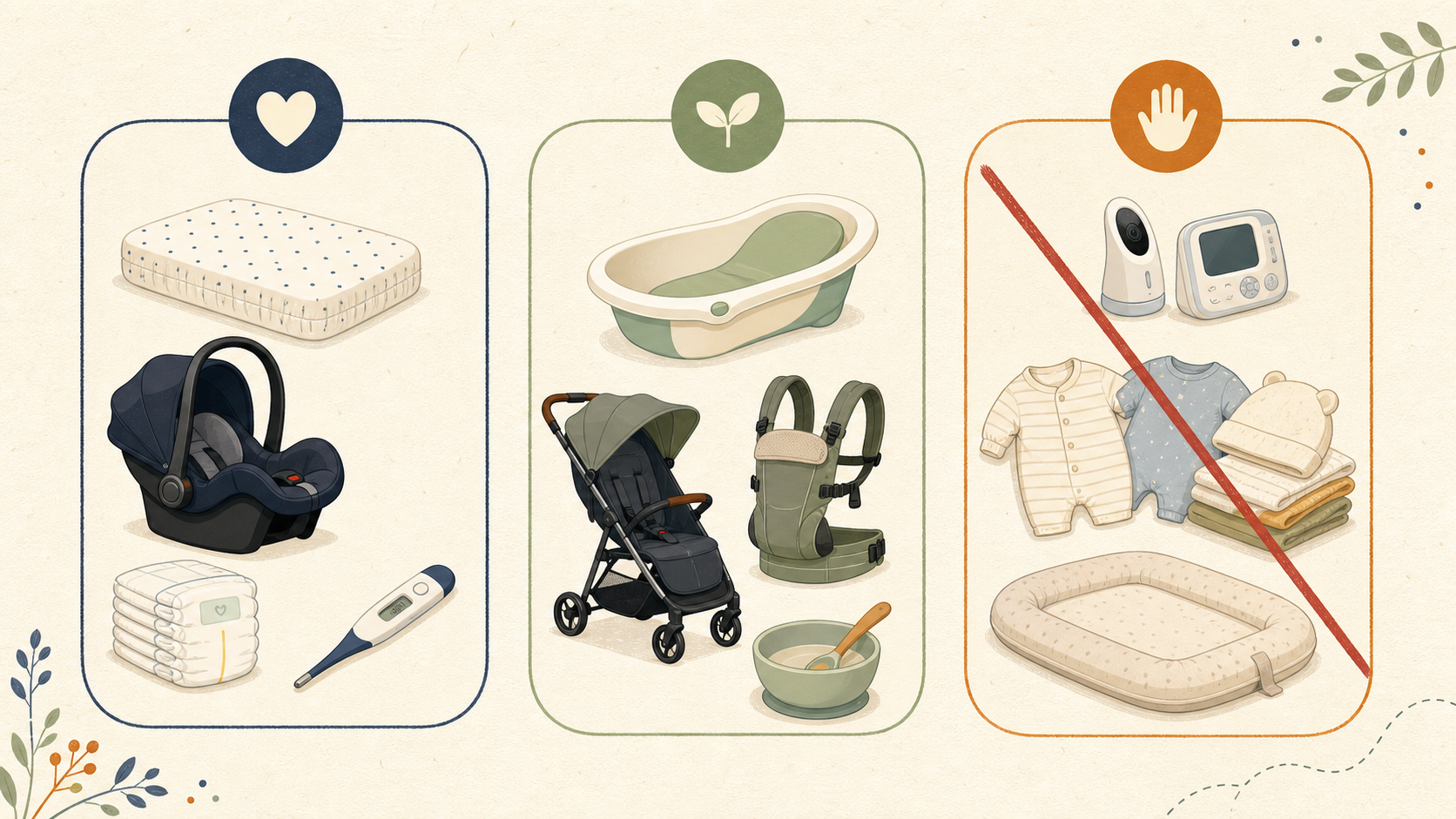
That is the useful lesson behind many compact Japanese homes: start small, choose washable multipurpose items, and add gear when a real need appears.
Why a Japanese checklist looks different
Japanese homes and American homes are not interchangeable. Storage, bathrooms, cars, climate, and product regulations can all differ. A small folding bath or compact stroller may solve a real problem in a Japanese apartment, while a U.S. family may need something that fits a larger vehicle, a walk-up building, or a different bathroom.
The label “Japanese” is not a safety standard. For safety-critical products—sleep surfaces, car seats, strollers, carriers, and infant tubs—check the U.S. model, English instructions, registration information, current recalls, and the child’s age and size.
Buy before birth: the safety-first essentials
A firm, flat sleep space
The American Academy of Pediatrics recommends placing babies on their backs for every sleep on a firm, flat, noninclined surface in a crib, bassinet, or portable play yard that meets current Consumer Product Safety Commission standards. Use a fitted sheet and keep pillows, blankets, bumpers, stuffed toys, and other soft items out of the sleep space.
This is one place where a cultural image can mislead. A Japanese-style futon or soft floor bedding should not be assumed to be an appropriate infant sleep surface in the United States. Follow AAP guidance and the instructions for a U.S.-compliant infant sleep product.
A rear-facing car seat that fits your child and vehicle
If your baby will ride in a car, choose a rear-facing seat based on the child’s age and size and confirm that it installs correctly in your vehicle. NHTSA advises reading both the car-seat manual and the vehicle owner’s manual. An infant-only seat is used rear-facing, and the back seat is the safer location.
Do not select a car seat only because it is popular overseas or connects to a stroller. Confirm that the exact model is intended and labeled for the U.S. market.
A small set of daily basics
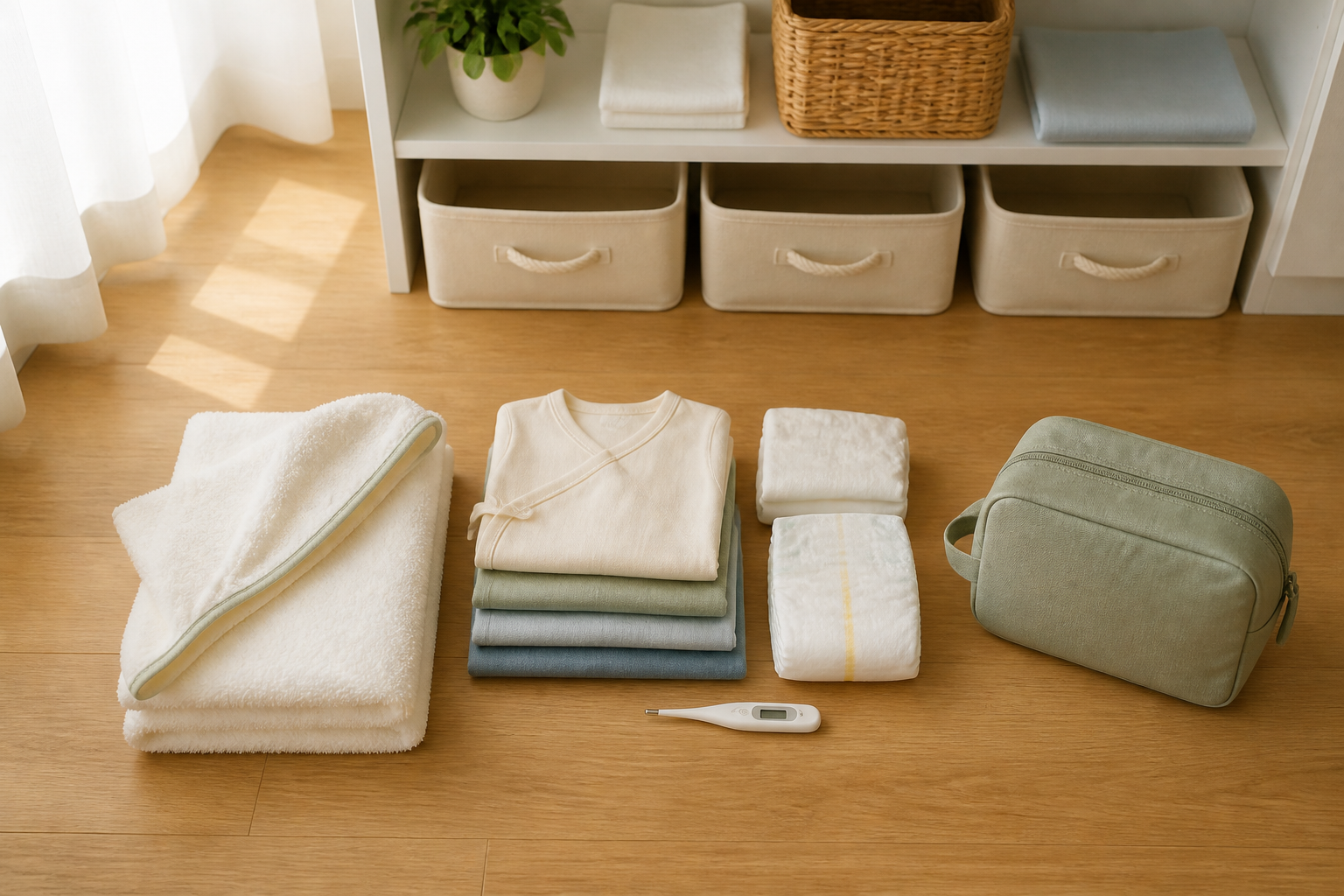
Your first-week list can stay short:
- diapers and wipes or your chosen cleaning setup;
- several easy-to-change outfits in more than one size;
- feeding supplies that match breastfeeding, pumping, formula feeding, or combination feeding;
- a digital thermometer and any care items recommended by your pediatrician;
- clean towels or washcloths;
- a safe place to put used laundry and diapering supplies.
Buying one practical week of supplies is more useful than trying to predict the next six months.
Easy Japanese ideas to borrow without overbuying
Washable towels and gauze cloths
Japanese baby departments often display many towels and gauze cloths. The useful idea is not that you need a special towel for every task. It is that lightweight, washable cloths can cover several jobs: drying after a bath, protecting a caregiver’s shoulder, or cleaning small spills.
One researched candidate is the Kontex Meringue Hooded Bath Towel, made by an Imabari towel manufacturer. Kontex lists it as cotton and describes a soft untwisted-yarn pile. We have not verified personal use, Amazon.com availability, or a U.S. ASIN, so treat it as an example to compare—not a family review. A clean, absorbent towel you already own may work just as well.
Keep towels and cloths out of the baby’s sleep space.
Multipurpose beats single-purpose
Before adding an item, ask:
- Can an item I already own do this safely?
- How long will this product fit the baby?
- Can it be washed easily?
- Where will it live when not in use?
- Does it duplicate another product?
These questions matter more than the country printed on the package.
Buy later: gear that depends on your baby and home
Infant bath tubs
An infant tub can be useful, especially in a small bathroom, but it is a bath aid—not a safety device. CPSC warns that babies can drown quickly in very small amounts of water. Keep the baby within arm’s reach at all times. If you must leave, take the baby with you.
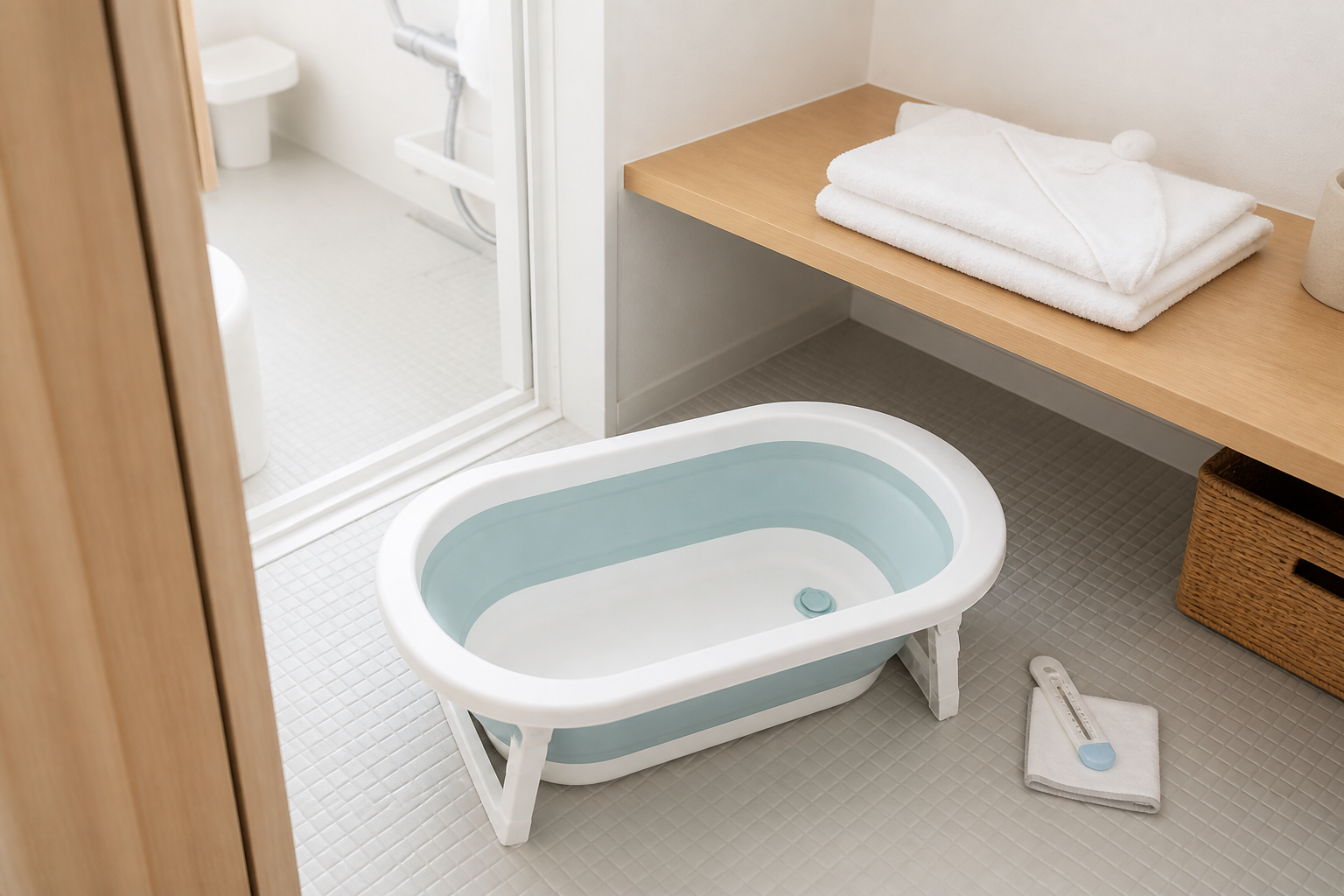
The Stokke Flexi Bath is the second product selected for comparison. Its folding design fits the small-space theme, but it is not a Japanese brand and we are not presenting it as something our family used. Before considering it, verify the current U.S. model, age range, instructions, registration information, and recalls. A heat-sensitive drain plug is only a visual cue, not a substitute for checking water temperature.
Stroller or carrier
You may not need both before birth. A stroller choice depends on stairs, sidewalks, car space, public transit, storage, and the baby’s age. Look for a stable frame, working brakes, and the correct harness. Avoid hanging heavy bags from the handle because they can make a stroller tip.
A carrier depends even more on fit. The baby’s face should remain visible, the nose and mouth unobstructed, and the chin away from the chest. Premature babies and babies with respiratory concerns may need individual medical guidance before carrier use.
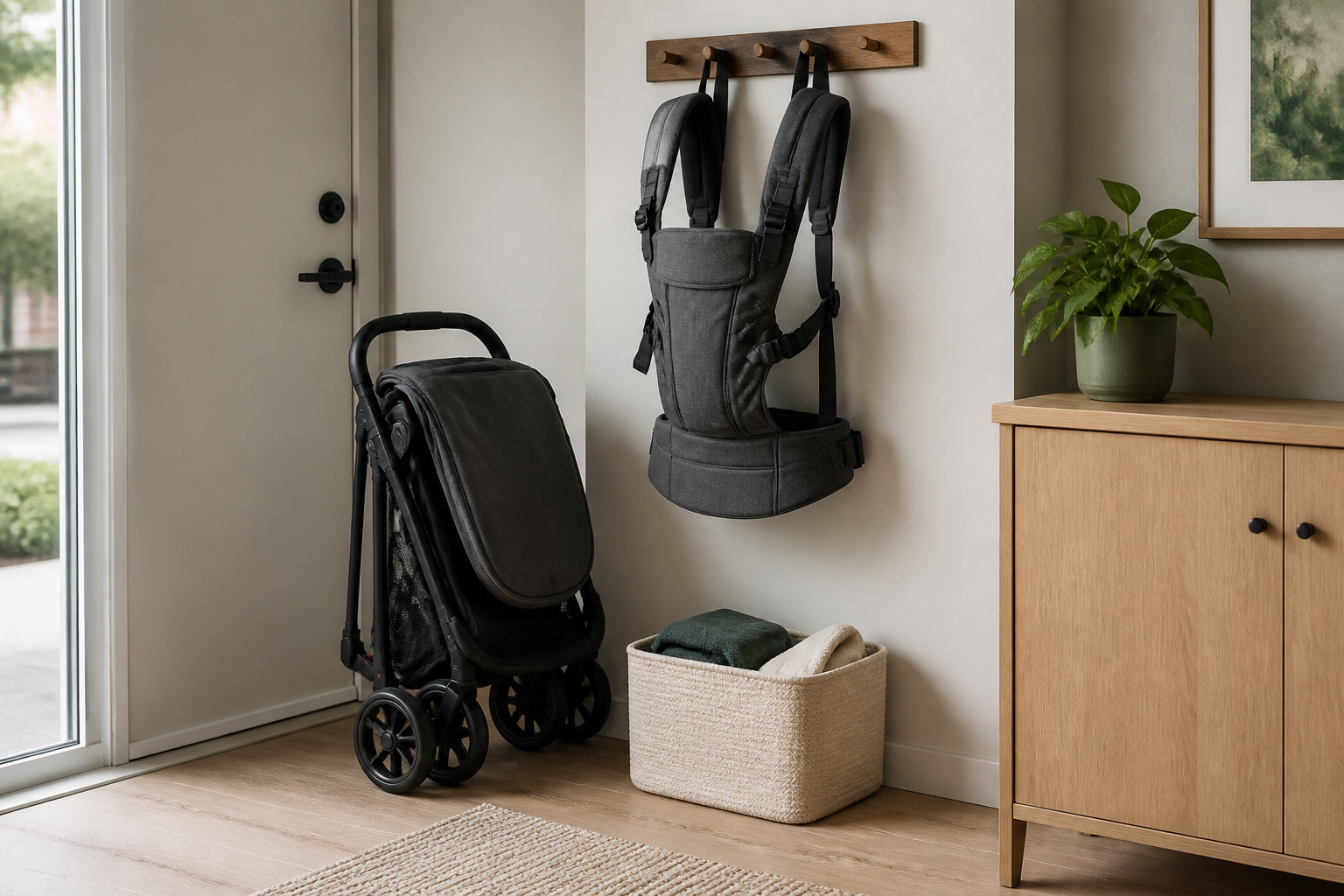
If a baby falls asleep in a stroller, car seat, swing, carrier, or sling, AAP guidance says to move the baby to a firm, flat, noninclined sleep surface as soon as practical.
Feeding tableware
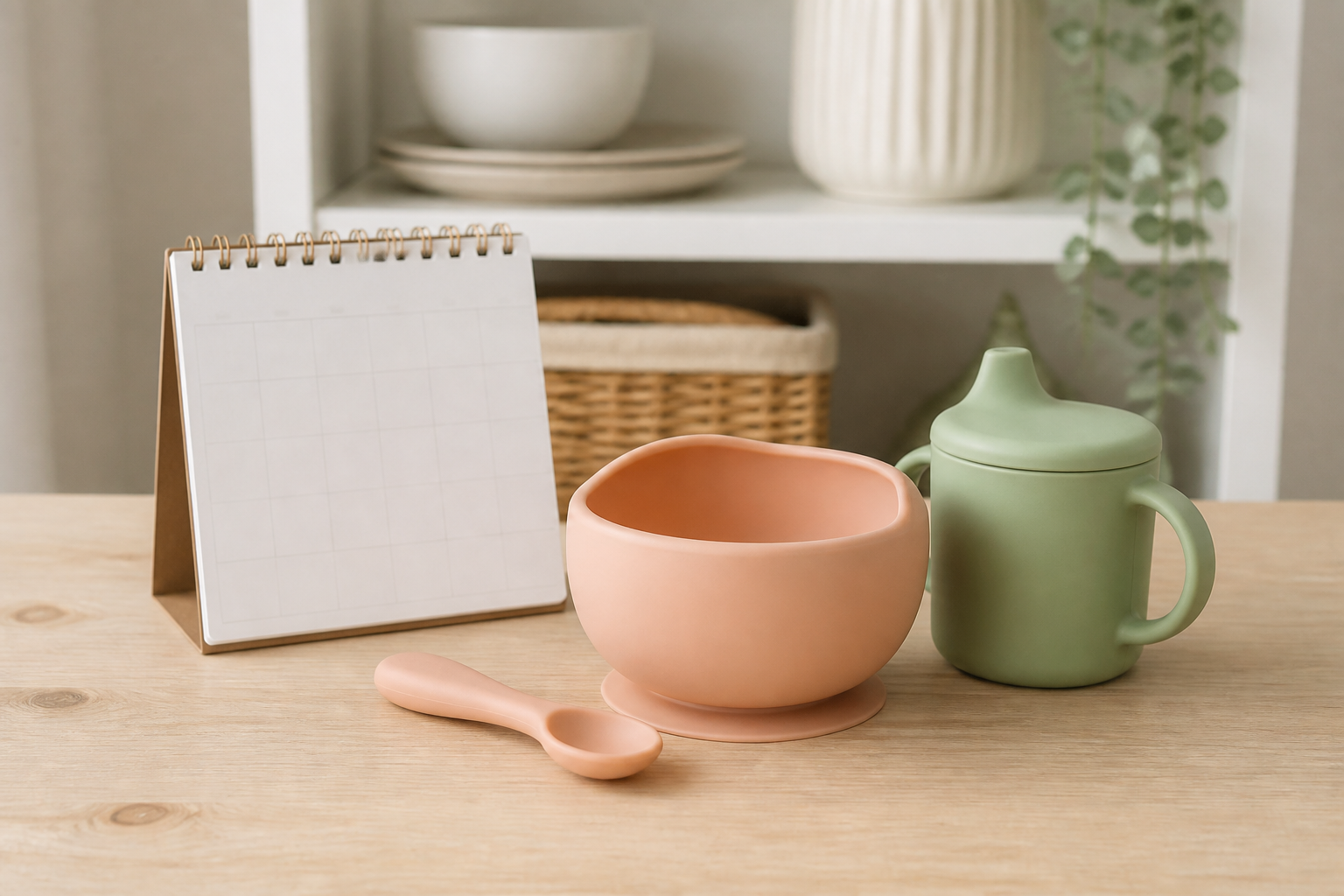
Bowls, spoons, cups, freezer trays, and suction plates can wait until the feeding stage approaches. Buying them during pregnancy may feel productive, but you will make a better choice when you understand your feeding routine and storage space.
Five product categories: what to check
| Category | When to decide | What to check | Simple alternative |
|---|---|---|---|
| Baby towel | Before or after birth | Washability, absorbency, loose decorations | A clean absorbent towel |
| Infant tub | After seeing your bathroom | U.S. labeling, stable placement, age range, recalls | A compliant basic infant tub |
| Stroller | After testing routes and storage | Harness, brakes, stability, fold, U.S. model | Borrow or test before buying |
| Carrier | After checking baby and caregiver fit | Clear airway, weight range, fasteners, condition | Professional fit check or wait |
| Feeding ware | Near solid-food readiness | Age range, intact parts, cleaning instructions | A small safe bowl and spoon |
Japanese products that need a U.S. safety check
Before importing or buying a secondhand safety-critical item, confirm:
- Is this exact model intended for the U.S. market?
- Can you read and follow the complete instructions?
- Does it have manufacturer identification and registration information?
- Is it subject to a recall?
- Does it fit your baby, home, and vehicle today?
For car seats, use NHTSA guidance. For durable infant products, search CPSC recalls and verify the manufacturer’s current documentation. “Sold online” does not automatically mean “appropriate for my situation.”
What you may be able to skip
- dozens of newborn outfits before you know which size fits;
- multiple products that all provide the same place to set the baby;
- pillows, positioners, loungers, bumpers, and loose bedding for sleep;
- a stroller and carrier before you know which one suits your routine;
- feeding equipment months before it will be used;
- products chosen mainly because they look good in a registry photo.
The goal is not minimalism for its own sake. It is to leave space—physically and mentally—for what your baby actually needs.
Your minimal baby essentials checklist
Before birth:
- [ ] Safe sleep space with fitted sheet
- [ ] Rear-facing car seat if traveling by car
- [ ] Diapers and cleaning supplies
- [ ] A small rotation of clothing
- [ ] Feeding supplies for your current plan
- [ ] Digital thermometer and agreed care basics
- [ ] Clean towels and laundry setup
Decide later:
- [ ] Infant tub
- [ ] Stroller
- [ ] Baby carrier
- [ ] Extra storage
- [ ] Feeding tableware
Frequently asked questions
Are Japanese baby products safer or better?
Not automatically. Some Japanese products offer thoughtful materials or compact design, but safety depends on the exact product, its intended market, current standards, condition, instructions, and correct use.
Can I use a Japanese baby futon in the U.S.?
Do not assume that a traditional or imported futon meets U.S. infant sleep guidance. AAP recommends a firm, flat, noninclined infant sleep surface that meets current CPSC standards, covered only by a fitted sheet.
Should I buy a stroller or carrier first?
Choose based on your earliest routine. A family using a car and wide sidewalks may prioritize a stroller. A family navigating stairs or transit may want to test carriers. Fit and safe use matter more than a universal ranking.
What should I be careful about when buying used?
Check recalls, missing parts, structural damage, manufacture date, instructions, and whether current standards apply. Car seats require extra caution because crash history may be unknown; follow NHTSA guidance.
How do I check recalls?
Use the CPSC recall database for consumer products and the manufacturer’s official support pages. Register eligible durable infant products so the manufacturer can contact you about safety information.
Your next step: divide your registry into three columns
Open your current list and label every item Buy Before Birth, Buy Later, or Skip/Borrow. Confirm the safety-critical items first. Leave the rest flexible.
You are not opening a tiny baby-supply store. You are preparing a safe starting point for one real family—and that can be much simpler.
Sources
- American Academy of Pediatrics: Safe Sleep
- CPSC: Durable Infant or Toddler Products
- CPSC: Infant Bath Tubs
- NHTSA: Car Seats and Booster Seats
- HealthyChildren.org: Baby Carriers
- HealthyChildren.org: Safe Strollers
This article provides general educational information, not individualized medical or safety advice. Follow current product instructions and consult your pediatrician for your baby’s needs.